
Why a foot health practitioner doesn’t treat fungal infections - and why treatment often doesn’t work

Updated: May 15

When people face a fungal infection of the nails or skin, they often expect a foot health practitioner to “treat it”. The logic seems simple: there’s a problem, there’s a specialist - surely they fix it.
In reality, it’s a bit more nuanced.
A foot health practitioner does not prescribe medication and does not treat fungal infections in the medical sense. That’s the role of a dermatologist. The role of a foot health practitioner is different, and without it, treatment often doesn’t deliver the results people expect.
And this is where it gets interesting: you can be doing “everything right”, and still not getting anywhere.
What a foot health practitioner actually does
A foot health practitioner works with the nail plate and surrounding skin.
They carefully reduce the affected areas of the nail and skin, decrease nail thickness, remove dense keratin build-up, and - most importantly - create access for topical treatments.
In simple terms, a foot health practitioner prepares the ground for medical treatment to work.
Because you can use the best products on the market and follow every instruction perfectly, but if they physically can’t reach the area that needs treatment, the results will be… underwhelming.
Without proper preparation, treatment is often ineffective.
Why treatment doesn’t work without proper preparation
A fungal infection is not just about what’s happening “inside”.
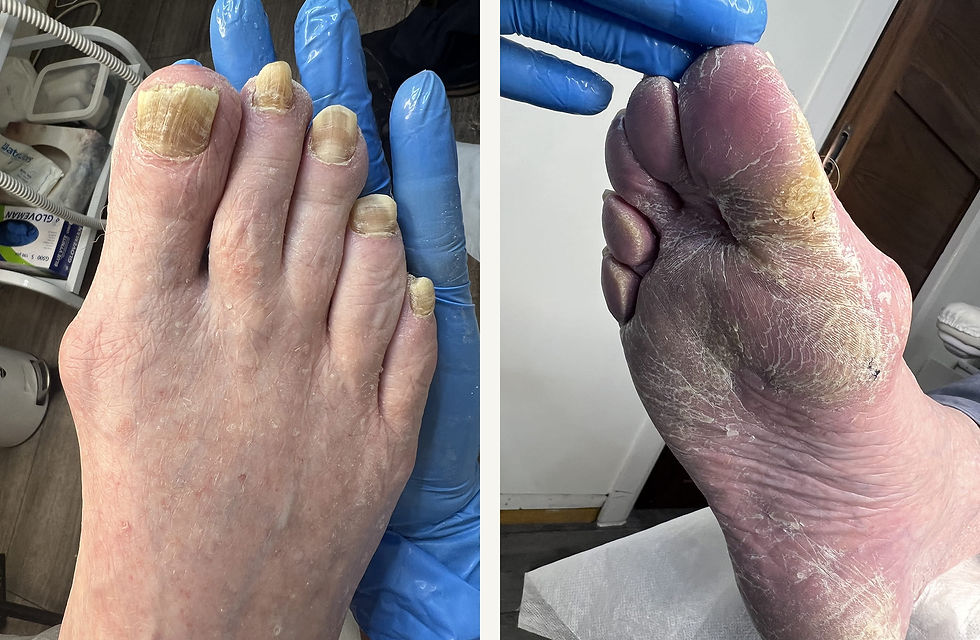
On the surface of the nail and skin, affected cells and dense keratin layers accumulate. This creates a very real physical barrier.
And here’s the frustrating part: the person is treating the condition, but the treatment doesn’t seem to work as expected.
Why? Because the medication simply cannot penetrate properly.
That’s why professional nail and skin reduction is not a cosmetic step. It’s a functional and essential part of the process. Without it, treatment has very little chance of working as intended.
How often is it needed
On average, affected nails and skin should be reduced every 4-6 weeks.
That said, this isn’t a rigid rule. It depends on nail growth rate, activity level, age, and the overall condition of the skin and nails.
The body, inconveniently, doesn’t follow a fixed schedule.
Is it painful
The procedure is carried out gently and is not painful.
Afterwards, people usually notice a feeling of lightness, reduced discomfort, and improved comfort when walking.
Occasionally, it’s one of those rare situations where a “treatment” actually makes things feel better straight away, which is always a pleasant surprise.
An important note
There are situations where a person cannot take systemic (oral) medication.
In these cases, regular professional care combined with topical treatments may not lead to full recovery, but it is essential for improving the condition and maintaining quality of life.
And that’s an honest approach: not promising miracles, but providing real, noticeable improvement.
Conclusion about fungal infections
Fungal infections are not managed by one specialist alone - they require a system.
Laboratory testing identifies whether a fungal infection is present and which organism is involved. A dermatologist prescribes treatment. A foot health practitioner ensures the conditions are right for that treatment to work, supports the patient throughout the process, removes excess keratin and nail build-up, and educates on proper foot hygiene.
If one part of this system is missing, expecting results becomes unrealistic.
Because this is not about a single action - it’s about a structured, consistent approach.
And as unexciting as it may sound, successful outcomes in fungal infections rarely come from a “miracle product”, but from consistency, correct strategy, and a fair amount of patience.


